Showing posts with label Joel W. Nelson. Show all posts

Tuesday, 27 September 2016

An Interview with Dave Harrity, Author of Our Father in the Year of the Wolf


Dave Harrity

Our Father in the Year of the Wolf
www.daveharrity.net

WordFarm
www.wordfarm.net

ISBN: 978-1-60226-016-0

Click here to read an excerpt of the book.


Dave Harrity was one of the first people I met when my family moved to Louisville, KY in the late 90s. We were both going into our freshman year of high school. I was still struggling to adjust to life in America after living overseas for most of the past 10 years, and Dave was a boisterous New Jersey transplant, already established and well-connected.

If I had to pick one person who I thought would become a respectable poet in my class, Dave wouldn’t have been my first choice. I knew him OK. We attended the same youth group on Sundays and hung out every once in a while. He was the guy most likely to swallow a lead fishing sinker, accidentally tip a canoe in ice cold water, or randomly inject “randy” into conversation, even in Geometry where a flustered “Madame Fro-bush” often failed to control the class.

But now that I think of it, there was the one time he conned some of us into going to a poetry reading we thought was going to be a killer ska show, and it probably would have been if the lead singers were singing instead of reading their poetry. Maybe it was an honest mistake. Maybe not. I didn’t realize Dave was a poet until after I had moved back to the area and looked him up on Facebook. He had a chapbook out, and had graduated from Spalding University’s Brief Residency MFA program, a program I’d later complete myself. I soon discovered that not only did he write poetry, but he was writing pretty good poetry.

Fast forward to today. Dave has had success with his book Making Manifest, teaches at Campbellsville University, and has played an important role in the formation of The Association for Theopoetics Research and Exploration and serves as creative editor for its associated journal, Theopoetics: A Journal of Theological Imagination, Literature, Embodiment, and Aesthetics. His two latest books are These Intricacies and Our Father in the Year of the Wolf.

Our Father in the Year of the Wolf is the type of book that helps bolster a poet’s reputation. Although the poems will often challenge the reader, the subtle but pervasive music is a strong enough engine to keep most readers engaged. Harrity's lines are often long, but pleasantly long the way Whitman’s lines are long. Lines that span the entire width of the page often fall naturally into pleasant "breaths."

The music of the poems serves as an ordering mechanism. Even when the poems are thematically dense, the music encourages the reader to trust the poet and to return to the poems again and find each time a richer experience. But even when it is difficult to process the poems intellectually, the book makes profound emotional sense. This is a great testament to Harrity's skill as a poet.

Dave took a little time out of his busy schedule to answer some questions by email.

First of all, congrats for releasing not one but two books of poetry in the past year or so. If you were to tell me in high school that you were going to be a poet, I don’t know that I would have believed you. So how did you come to be a poet? 

First, thank you for asking me to do this—I’m honored and full of gratitude! As for your question: Hah! I was a poet in high school, but I was quiet about it. No one knew except one of our classmates. I wrote her poems to try to get her to date me, and it worked for a while. She liked poems. The relationship didn’t last, but I kept writing. And just never stopped really. I became a poet by doing, not by reading. That’s important for me. I’ve since developed a habit of study, but it came after the fixation I had with creating.

We are both graduates of Spalding University’s MFA program. I can understand some of the criticism MFAs receive, but my experience at Spalding was overwhelmingly positive. Briefly, what influence has your MFA had on your literary career? 

I had a good experience at Spalding as well, and I think that had to do with the literary community it provided for me. It was a place where I didn’t have to explain myself—I could have this strange, shared artistic fixation; I could ask questions to friends and read and write alongside them. The MFA taught me how to demand meaningful interactions with other artists. I worked so hard in that program—took full advantage of my profs and peers. The MFA helped me understand how important it is to have literary and creative relationships—I still have some very close relationships from Spalding.

Of your two most recent books, These Intricacies seems more contemplative and accessible, while Our Father is denser, darker, and more experimental. Did you write these books with a specific purpose in mind or was their creation more organic in their development? 

They both sort of materialized as their own projects. Most of the poems in both books were written post-MFA. I was writing all the poems at the same time though, since about 2007. The poems in TI are certainly older, and an editor approached me about making a book. At the time, I had a manuscript. He looked at it and asked me to send as many other poems as I could. We worked from there to make the book.

Our Father was always conceived as a book-length project. I kept writing the strange poems and just piled them all in a folder. After about four years of this, I pulled the folder out and began stitching them together.

When reading Our Father for the first time, I was struck by its remarkable depth, and I feel like I have a richer experience each time I revisit the book. It’s exquisitely woven, whether it’s the thematic movement from poem to poem, illustrations of the moon passing through different phases, or the interaction of poem titles. What was your revision process like for this book? Did you focus more on the individual poems or the work as a whole? 

Thanks for saying that—man. That’s a really wonderful compliment and I’m glad it worked that way for you. I hope the same for all who read it! Originally, the manuscript was over a hundred pages. Which was crazy. I cut it down to sixty pages. Lots and lots and lots of cutting—ruthless. I tried to trust what the poems were trying to be, which was unfamiliar at first. But as the process moved forward, I began working in this strange, long tercet, and the voice in the poems began to ring clearer. The form really helped to order the book, which had never happened to me before. It was an uneasy delight the whole way.

You mention hagiography in the author’s notes. Could you briefly explain what that is and maybe give an example of the role it plays in this collection? 

Yeah… that idea—the narratives of the lives of saints—has always captivated me. The lives of early martyrs in the Christian tradition, especially. The stories are so fanciful and bizarre—they’ve always seemed to be the most interesting secrets of the Christian Church, though similar styles or narrative abound in other faith traditions.

In Our Father, there is this cursed family—focused mainly on the father and son. I read a story about St. Natalis of Ireland who cursed the Meath Clan when they wouldn’t repent from their evil. He cursed them to be werewolves. I just found the whole story captivating and thought I could use it, quite loosely, as the basis of the book since monsters/beasts—wolves, in particular—were dominating the metaphorical structure of the book.

In Making Manifest you argue for writing as spiritual practice. Our Father is full of biblical allusions and influence from other religious sources, but the book seems to embrace mystery and acknowledge nuance rather than evangelize or provide Sunday school answers. How is Our Father a reflection of your theology? 

Oh dear… I’m going to have to speak generally, and you’ll have to forgive me for it. I feel so estranged in/from discussions of faith and art. In my travels and teaching I’ve learned most believing people don’t want art, especially if it seems contrary to whatever they’re bred to believe, or—at the very least—art isn’t a priority of the faith experience for the majority of religious folks.

Sure, there are people who are serious about their faith and their art—I know many such people deeply, and I’m not talking about them here—but art seems to be largely dumbfounding to “the faithful” unless it does evangelize or affirm what’s learned in Sunday School. Whatever that nonsensical conglomeration of creative things is, I can’t usually name it as art or artfully made. On top of that, making art is an act of existence, of living into one’s embodiedness—one’s humanness—and there are more than a few people in the pews that think that existing as one is is sinful.

I told a student recently—he writes poems—that if he wants to be an artist and is a person of faith that he should bury that faith so deep into his poems that no one but someone just like him will know it’s there. If you ask me, all things worthwhile sing to one another from the depth. I also told him not to trust people who claim faithfulness but have no creative life.

Generally speaking: it’s usually dangerous or unfair to discern a person’s theology through a person’s art, I think. And the acts of mixing theology and art—with some fantastic exceptions—are often irrelevant disasters that suffer from didacticism and are blind to how extraneous, inappropriate, or just plain silly they are. My work has been there. That said, there are so many brilliant artists of faith that get little attention outside of literary circles—God, so many brilliant ones. And that’s a sin—that their voices aren’t known. As for Our Father and me, I don’t know if it reflects a theology, much less my own.

You experiment with longer lines in many of these poems, which can be dangerous when paired with the kind of weighty subject material and dense language you use in this book, but your lines have a natural “breath” to them that allows the reader to process them in small chunks. You also experiment with space and breaks within the line in a way that pays respect to form and tradition, but is fresh and contemporary. Could you talk about the role form played in developing these poems? 

As I said before, the long tercet became the book’s fingerprint. With lines like that, however, I had to really work to understand the caesura, which is something that alluded me until this book. Also, in this book, I worked to master metrical structures, which are important to me as a poet, and have always been important to my work. I think I gained some ground, but what I love about poems is that I will spend the rest of my life working on sounds.

How do you approach titling poems? You do it so well. “If the Silver Could be Given Back & Prophecies Erased” is a brilliant title, and the titles as a whole in this book carry a lot of weight and significance.

That’s a really tough question—in this book I tried to embody the poem with some kind of Scriptural, historical, or philosophical referent. Sometimes it worked, sometimes it didn’t.

As a parent to two kids under the age of 4, I struggle to get a lot of writing done. You have two kids, a wife, a job, and a literary career. How do you find time to write and be a part of the literary community? 

You don’t find it, you make it. If my writing doesn’t get done, I’m the only thing that forced it not to happen. Make time. No one else is going to do it for you. But if you’re lucky and smart you will surround yourself with people who remind you of what you should do and help you do it. And don’t forget to play with your kids every day.

Lastly, what projects do you have on the horizon that we should be watching for?

Right now all I’m doing is working on a poem every day and playing blues guitar. I don’t think anyone will be hearing much creatively from me any time soon. But if you see me, say hello!

Thursday, 11 February 2016

Conflict Resolution for Holy Beings by Joy Harjo

Joy Harjo
Conflict Resolution for Holy Beings

W. W. Norton & Company
http://www.wwnorton.com

ISBN: 978-0-393-24850-0


Review of Conflict Resolution for Holy Beings

by Joel W. Nelson

In an election year, such as this one, we are constantly bombarded with claims of what America is and what the country represents. We are reminded of how hard-working and resilient Americans are. Our country, we are told, is great because of something innate in our make-up, that we are special or, as some may believe, divinely appointed to be a beacon of light to the world. Often blinded by the myth of America, we justify or completely ignore the blemishes of our past. The ideal is all that matters. Entire populations are swept under the rug in order to keep the myth intact.

Joy Harjo’s latest release, Conflict Resolution for Holy Beings reminds us America is full of contradictions, that it--to borrow from Whitman--contains "multitudes." Harjo is a member of the Mvskoke Nation, a people once prominent in the Southeastern U.S. before being displaced, often forcefully, to Oklahoma reservations in the 1830s. Like other Native peoples, the Mvskoke were not afforded the rights America promised to some:
Where we lived, the settlers build their houses. Where
we drew fresh water, the oil companies sucked oil.
Where deer ran in countless numbers, we have a new
Mall. Where the healing plants thrived; the river is
Burning. Now, a fence cuts the road home. Next the sky
Will be tethered, and we will pay for air.
Conflict Resolution for Holy Beings alternates between standard titled poems and untitled poems and prose poems. The interplay between the titled and untitled pieces creates a dialog, or even a call and response, between more commonplace and human subjects and a more universal and timeless voice.

History weighs heavy on this volume, as does mythology. “Rabbit Is Up to Its Tricks” depicts the account of Rabbit creating a clay man to ward off loneliness. Being a trickster, Rabbit taught man how to steal chickens, corn, and even a man’s wife. Stealing leads to more stealing as man becomes more and more greedy:
Once he took that chicken he wanted all the chickens.
Once he took that corn he wanted all the corn.
And once he took that wife, he wanted all the wives.
He was insatiable.
Then he had a taste of gold and he wanted all the gold.
Then it was land and anything else he saw.
His wanting only made him want more.
Of course, this story is not just a myth but an allusion to the European occupation of America. But Harjo does not merely point the finger at one group of people. Even her own people and the Native American tribes of America are tainted:
We lost track of the purpose and reason for life.
We began to forget our songs. We forgot our stories.
We could no longer see or hear our ancestors,
Or talk with each other around the kitchen table.
Perhaps at its core, Conflict Resolution for Holy Beingsis an attempt to reclaim the songs and stories of a people and to create new songs in the modern landscape.

References to jazz are prominent in this book. While the form initially arose from African and slave folk songs, Harjo appeals to it as a language that binds people together. Jazz has it's roots in suffering, but it is also transcendent. It represents the America Harjo feels comfortable being a part of.

Although music plays an important thematic role, Harjo’s use of the song as a poetic form is not always successful. Lines like “I didn’t want to make the same mistakes. / I had to find my midnight star” (“Falling, Falling”) and “If you’ve found love in the circle then hold onto it, not too tight / If you have to let love go then let it go” ("Goin’ Home") seem trite and forgettable when surrounded by more original and meaningful poems.

One of the more compelling poems in the collection is one that shares the book's title. In “Conflict Resolution for Holy Beings,” Harjo evokes multiple voices as she takes the poem through a five step process of conflict resolution. Whereas once it was Rabbit, now the U.S. government is playing the trickster, breaking promises and laying claim to a land that was never rightfully theirs. Reversing history is impossible. Finding a way forward is the only option:
We gave thanks for the story, for all parts of the story
because it was by the light of those challenges we knew
ourselves—
We asked for forgiveness.
We laid down our burdens next to each other.
It is astonishing Harjo finds any room for optimism, especially considering this nation's centuries-long history of subjection and abuse of Native Americans. Harjo does not shy away from the hard truth, but she conveys it in a way that makes resolution seem possible, perhaps even probable. Conflict Resolution for Holy Beings is political, but not obnoxious. It is a book of protest. It is both a reminder and a rallying cry. As America continues to confront--or many times, deny--its racial and institutional biases, we need voices like Harjo’s calling out, “Hello! We’re still here. We matter.”

____________________________________

Joel W. Nelson spent most of his childhood in the sub-Saharan countries of Burkina Faso and Cote d'Ivoire. He has an MFA in Poetry from Spalding University and lives with his wife and son in Louisville, KY. His poems may be found in the Bellevue Literary Review, the Found Poetry Review, The Louisville Review, and A Narrow Fellow.

Sunday, 21 June 2015

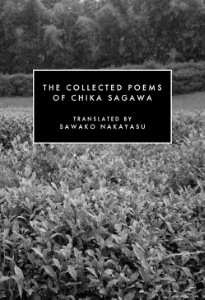
The Collected Poems of Chika Sagawa


The Collected Poems of Chika Sagawa 

Chika Sagawa
The Collected Poems of Chika Sagawa
Translated by Sawako Nakayasu

Canarium Books
http://www.canarium.org

ISBN: 978-0-9849471-6-4


____________________________________

Review of The Collected Poems of Chika Sagawa
by Joel W. Nelson
I believe poetry is the study of language. Unlike spoken language, it is a language of the heart, not visible from the surface. It is the filling of the air with words selected out of deep contemplation. Not a gathering of the meanings of words spoken to be spoken, but an attempt to say something, or to reflect something. Very sparse and most strict, it is a skillfulness right on the brink of burning out like a flame.
          - "When Passing Between Trees"
Sagawa Chika was born in 1911 in Yoichi, Hokkaido in Japan and lived a short life, dying of stomach cancer in 1936. Although she was sickly nearly her entire life, the poems she left behind are brilliant and bold. They are vibrant with color and imagination. Her Collected Poems, translated by Sawako Nakayasu, is a testament to Chika's genius. The translations feel fresh and could easily pass as contemporary work.

Chika's poems are very much a collision of imagination and reality. They are full of unexpected twists and turns. As soon as the reader might begin to reach a level of understanding, Chika is likely to direct the poem in a new direction:
A thicket of asparagus
Dives into the dirty afternoon sun
Their stems cut off by glass
Blue blood streams down the window
And on the other side
Is the sound of a fern unfurling
          - "One Other Thing"
In the prose piece "Had They Been the Eyes of Fish," Chika observes, "Perhaps the way poetry finds expression is by taking materials that had once been reflected in reality and returning them to the realm of thought." When these "materials" are returned to thought, they do not always retain the constraints of reality. There is perhaps a hint of linearity in "One Other Thing," but the way each element is presented is surprising. One would not expect the poet to move from the asparagus diving into the sunset to the blue blood in the window before ending with "the sound of a fern unfurling." The earlier images evoke a kind of chaos, while the final image represents a very slow, deliberate order.

In the essay “Vorticism,” Ezra Pound–whose Imagist ideals were largely extracted from the study of Chinese and Japanese poetry–describes a type of poem “where painting or sculpture seems as if it were 'just coming over into speech.'" This is the poetry of the image. Chika's poetry operates in this sphere, but unlike the stereotypical Japanese image, her images are often abstract:

Rains like flower petals.
Hit by a heavy weight, insects descend the tree shade.
Gathering at the mast wall, trailing a faint breeze – sounds are
   killed by the sun, the waves.
My skeleton places white flowers upon it.
Interrupted by thoughts, fish climb the cliff.
          - "Afternoon"
At first glimpse, "Rains like flower petals" is a simple, if not overwrought simile. The line would normally kill a poem, and yet in the broader context, the line fulfills the function of a surreal image rather than mere simile. If "Afternoon" were to be represented on canvas, perhaps the resulting artwork would be similar to a Salvador Dali painting. Meaning in her poems is often allusive. Wallace Stevens observes in "Adagia," "A poem need not have meaning and like most things in nature often does not have." A reader intent on extracting meaning from Chika's poems will likely come up empty-handed. This is not to say her poetry is meaningless, but rather it is poetry better experienced rather than understood, although the experience of the poem, on its own terms, is itself a sort of understanding.
I have a bit of a fever, my back hurts and I cannot stand up. I eat apples and pears. In the afternoon I chat in quite a loud voice.
          - from "Diary"
One might only speculate what Chika could have accomplished had she lived a longer life. As stunning and impressive as her writing is, it is the work of a young poet brimming with potential but not fully reaching it. And yet ironically, had Chika lived to old age and had these poems been summation her life's work, they would be enough.
____________________________________

Joel W. Nelson spent most of his childhood in the sub-Saharan countries of Burkina Faso and Cote d'Ivoire. He has an MFA in Poetry from Spalding University and lives with his wife and son in Louisville, KY. His poems may be found in the Bellevue Literary Review, the Found Poetry Review, The Louisville Review, and A Narrow Fellow.

Saturday, 14 February 2015

Books That Call Us Back

Happy Valentine's Day, poetry lovers! This month three of our blogging team present the poets they consider touchstones―books and writers whose words touch deeper chords, serve as a hallmark of poetic achievement, continually surprise with original beauty. They inspire us with poems that cause us to breathe in, true to the origin of the word; in essence, to breathe more fully into our own perceptions and truths.

Karen George touches on several poets whose work most moves her, with special emphasis on Li-Young Lee's collections. Joel W. Nelson focuses his reader's light on the haiku of Kobayashi Issa in Spring of My Life. Barbara Sabol explores the work of Jane Hirshfield, highlighting in particular the book The Lives of the Heart.


___________


***KAREN GEORGE: My list of touchstone poetry books that I return to again and again would include all four of Li-Young Lee’s poetry collections (The City in Which I Love You, Rose, Book of My Nights, and Behind My Eyes), because of how his poems are layered with meaning, haunting in their tenderness and longing, deeply spiritual, yet grounded in the world of the senses. I’d also include New and Selected Poems, Volume I and II by Mary Oliver, and W. S. Merwin’s Migration: New and Selected Poems, because of how they teach me to pay attention, and immerse me in their reverence for the beauty and vulnerability of the natural world. Pablo Neruda’s One Hundred Love Sonnets would hold a place on my list of vital poetry books because of his sensuous imagery, and the intimacy, passion and mystery at the core of his poems. Jane Hirshfield’s After, Come, Thief, and Given Sugar, Given Salt earn a place on my list because of their contemplative nature, and how her spare yet multi-layered poems suggest as much by what she does not say as what she does. I’d include Naomi Shihab Nye’s Words Under the Words: Selected Poems for her direct, simple language, and her sense of urgency and compassion in writing about moral concerns and injustices. Lastly, Marie Howe’s The Good Thief and What the Living Do would hold a place on my list of touchstone books for the powerful, nuanced ways she handles complex emotional issues involving relationships and loss.


***JOEL W. NELSON: “Touchstone” isn't exactly the first word to roll off my tongue in the morning. What does it mean anyway? At one point, a touchstone was a literal stone used to measure the quality of gold and silver. Applied to our topic of discussion, a “touchstone” book of poetry can be understood as a book that one uses to judge the quality of other works, possibly even ones own. Kobayashi Issa's The Spring of My Life, translated by Sam Hamill, is such a book for me.

 Language is an essential compromise. Words can give life to a poem, but they can also kill a poem. The secret is in finding the right balance, and Issa is a master. His poems explore the whole range of emotion from light humor to deep suffering. When confronting suffering, the temptation is always to say too much instead of handling it with restraint, something Issa does beautifully. Even when his daughter dies of small pox, Issa manages to hold back:
 This world of dew
 is only a world of dew--
 and yet...oh and yet... 
This poem kicks off a series of poems by various haiku poets who also lost children. The haiku are brilliant mini-explosions of raw emotion. If there is one trait I admire most in a poet is his or her ability to transcend the page, to bring the reader into a world bigger than what they expected. If the poet can use the poem to manipulate not just the words on the page but the space outside the poem, is there anything more awesome than that?

 The old masters are old masters for good reason. I constantly fail to write the poems I want to write, whether it's because of a craft related failure or a lack of taste. For some reason, the poets of China and Japan reinvigorate me when I feel defeated and humble me when I become too proud. The Spring of My Life is a book that I constantly revisit. The feeling I get when reading these poems is a feeling I seek in other books of poetry and a feeling I aspire to share to my readers. Maybe one day, I will succeed, but until then, always the struggle.


***BARBARA SABOL: Joy, Sorrow and Every Moment In Between: Jane Hirshfield's The Lives of the Heart 

There is a good handful of poetry books I return to―for comfort (Kunitz, Merwin), for inspiration (Millay, Yeats), for wisdom (Hopkins, Rumi), for sonic brilliance in the nearly-edible vocabulary, the sheer rhythmic flow of a line (Dickinson, Heaney), for a well-wrought narrative (Bishop, Haas), for the exalted pleasure of discovering one's own perceptions exquisitely expressed (Glϋck, Doty). Any one of these poets could serve as exemplar "touchstone" poets. The one poet I keep closest, however, read again and again, the poet whose work embodies all of the above qualities, whose poems resonate into my day, is Jane Hirshfield. I own most of her books, including her collections of fine, illuminating essays. Of her books of poetry, The Lives of the Heart, published in 1997, has long represented a standard of poetry making to me, and stands out in high-relief on my bookshelf. Its pages are yellowed and the sumptuous cover holds a permanent curl at the bottom right-hand edge. What defines this collection, in particular, as my touchstone book of poems, is only secondarily its clear cohesion around the conceit of heart-as-symbol, its accessible diction, its beautifully rendered images, its philosophical and spiritual depth. Each time I re-read certain of the poems, I am struck anew by the quiet yet authoritative voice that layers meaning and image, image and meaning, such that I discover yet another strata of connotation, of connection to the poems' sensibility and sense enacted by its original and beautiful language. The poems ring true, the clapper chimes in fresh tones, even if I've read that same line five or fifty times.

 The collection is organized in four sections, each a full complement of one heart-theme: I) Heart Starting and Stopping in the Late Dark; II)Not-Yet; III) The Sweetness of Apples, of Figs; IV) Each Happiness Ringed by Lions. The four sections together present the full scope of emotional and spiritual responses to the world, to loneliness, loss, longing, joy, via a heart metaphor.

 A parallel theme of mortality and the inevitable tension that death/loss imposes on our waking lives, our joys, runs through the book. In the poem, "Not-Yet," the speaker turns her "blessings like photographs into the light," while "over my shoulder the god of Not-Yet looks on:/Not-yet-dead, not-yet-lost, not-yet-taken." The speaker accepts the temporary nature of her blessings: "I move my ear a little closer to that humming figure,/I ask him only to stay." The undertone of mortality completes the full circle of life, as enacted in these poems; eventually both "salt heart" and "abundant heart," in their ardent beating, says the god of Not-Yet, will someday cease.

 The book opens with the title poem as prelude to the collection; it presages the themes of each of the four sections in startlingly beautiful, textured images:

The Lives of the Heart 

Are ligneous, muscular, chemical.
Wear birch-colored feathers,
green tunnels of horse-tail reed.
Wear calcified spirals, Fibonaccian spheres.
Are edible; are glassy; are clay; blue schist.
Can be burned as tallow, as coal,
can be skinned for garnets, for shoes.
Cast shadows or light;
shuffle; snort; cry out in passion.
Are salt, are bitter,
tear sweet grass with their teeth.
Step silently into blue needle-fall at dawn.
Thrash in the net until hit.
Rise up as cities, as serpentined magma, as maples,
hiss lava-red into the sea.
Leave the strange kiss of their bodies
in Burgess Shale. Can be found, can be lost,
can be carried, broken, sung.
Lie dormant until they are opened by ice,
by drought. Go blind in the service of lace.
Are starving, are sated, indifferent, curious, mad.
Are stamped out in plastic, in tin.
Are stubborn, are careful, are slipshod,
are strung on the blue backs of flies
on the black backs of cows.
Wander the vacant whale-roads, the white thickets
heavy with slaughter.
Wander the fragrant carpets of alpine flowers.
Not one is not held in the arms of the rest, to blossom.
Not one is not given to ecstasy's lions.
Not one does not grieve.
Each of them opens and closes, closes and opens
the heavy gate―violent, serene, consenting, suffering it all.

One poem that catches my breath with each reading, and that I'd like to share here, is "Not Moving Even One Step," in which longing and emotional fulfillment are enacted by the figure of a solitary horse in light rain:

Not Moving Even One Step
The rain falling too lightly to shape
an audible house, an audible tree,
blind, soaking, the old horse waits in his pasture.
          He knows the field for exactly what it is:
          his limitless mare, his beloved.
          Even the mallards sleep in her red body maned
          in thistles, hooved in the new green shallows of spring.
Slow rain streams from fetlocks, hips, the lowered head,
while she stands in the place beside him that no one sees. 
The muzzles almost touch.
How silently the heart pivots on its hinge.

How strange and yet natural that the "she" horse appears in the second stanza. It is the old horse's open-heartedness to love's possibilities and mysteries that allows the female horse to inhabit the empty space that only he, in his blindness, can see. And how quietly and surely that last stanza completes the poem, with the impossible observation (unless it is the heart that perceives the muzzles almost touching) in the simple sentence in the penultimate line, followed by the philosophical musing of the closing line. Jane's poems seem to turn on insights such as "How silently the heart pivots on its hinge," which carry a contemplative quality through the collection, adding a multi-hued resonance.

A new book of poems by Jane Hirshfield, titled The Beauty, will be published this March by Knopf. If it's possible for another book to rival the full emotional and spiritual range found in The Lives of the Heart, it may be this newest. I relish the idea of another book of Jane's; another collection that promises to express the unarticulated and private self―poems that, as in "Three Foxes by the Edge of the Field at Twilight: ". . .look back from the trees,/and know me for who I am."

Sunday, 16 November 2014

Forgiveness Forgiveness by Shane McCrae

Shane McCrae
Forgiveness Forgiveness

Factory Hollow Press, 2014
http://www.factoryhollowpress.com

ISBN: 978-0-9835203-1-3


Reviewed by Joel W. Nelson.

Shane McCrae was hired to teach for the Spalding University brief-residency MFA program as I was completing my final semester in 2013. During my graduating residency, I was fortunate enough to be a part of a workshop he led along with Greg Pape. McCrae came across as humble, often self-deprecating, guy who is smart, talented, hard working, and an all-around cool guy. To date, McCrae has released three full-length books of poetry: Mule, Blood, and Forgiveness Forgiveness. His fourth book, The Animal Too Big to Kill, is forthcoming from Persea Books. McCrae is a graduate of Harvard Law School and the Iowa University Writers' Workshop. In addition to teaching at Spalding University, he is an assistant professor in the Creative Writing program at Oberlin College.


____________________________________

Review of Forgiveness Forgiveness

Forgiveness Forgivenesscomes at a time when race relations are tense. The case of Michael Brown still looms large in the news, even as the stories of Eric Garner, John Crawford III, and countless others begin to fade. A society assumed by some to be post-racial is proving to be anything but. There are still two Americas. We are still divided, still struggling. We claim to be equals on the one hand, while equality is denied on the other. The narrative is still one-sided, but it is very much in flux.

* * * 
My grandfather liked to paint pictures
of Native Americans discovering water
as if water hadn't existed before a white
man painted it, wearing expressions of
uncomprehending awe, crouching to
touch the river.
          -“How My Grandfather Painted Water”

Shane McCrae's third full-length book of poetry, Forgiveness Forgiveness, is a powerful, haunting work that deals with issues of identity, race, family, abuse, belonging, and finding a way to move forward. The poems are mostly unpunctuated, often ungrammatical. Ideas burst forth and crash into each other, as if the speaker is recollecting things for the first time and hasn't had time to filter these thoughts through the conventions of syntax. The effect, in McCrae's hands, is masterful. Although McCrae has made use of similar techniques in previous books, Forgiveness Forgiveness feels even more authentic, personal, and emotionally raw.

Forgiveness Forgiveness is structured in two halves separated by “A Pastoral Interlude.” Each half contains three sections, “The Visible Boy,” “Materials Sketch,” and “Draft Epilogue,” with the second half of the book providing alternate versions of the first three sections.

The first half introduces Little Brown Koko, a quasi-allegorical figure pulled from a racist children's book the speaker found in his grandparent's home as a child. Koko walks barefoot, steals watermelons, strolls along picket fences, and gets beaten by his mother's wooden spoon. He is essentially a puppet, a stereotype, a black character who is thrust into the imaginary world and manipulated by a white author and a white illustrator. The voice of Koko and the other black characters in the book are not authentic voices but instead racist fabrications:
in the book as I remember it
The illustrator indicates the motion / With action lines 
Parentheses surround the rolling pin

Parentheses surround 
Little Brown Koko running from the house 
The black of the parentheses

Is different from the black of his brown skin 
The two blacks tell the reader 
everything the reader needs to know about him 

Like two-way mirrors
          - “6. The Two Blacks” from “The Visible Boy”
The second half of the book turns its focus to the speaker, a man separated from his black father and white mother and raised by racist grandparents. The grandparents are incapable of acknowledging the speaker's father and attempt to twist family history to further alienate him and minimize the speaker's blackness, if not erase it completely:
[…] I couldn't remember my father
anyway, because I was three when
my grandparents took me from him
and they never told me that, anyway,
they told me he had abandoned me
          - “How My Grandfather Painted Water”
In addition to being a racist, the grandfather becomes sexually and physically abusive. The resulting confusion and dissonance caused by this troubling home environment prove to be fertile ground for McCrae's poetry, made even more compelling when considering the dynamic between the speaker's story and that of Little Brown Koko.

While the two halves of Forgiveness Forgiveness interact and inform each other, they are not mirror images. The parallels between Little Brown Koko and the speaker are more metaphorical than literal and are understood to speak to--but not necessarily for--a broader community. The poems in the second half of the book are more personal, perhaps even confessional. The early Koko poems are lighter in tone and gradually become darker and more grotesque as the racism becomes more overt and violent. The progression of the second half of the book is generally the opposite. Koko is left ravaged, but the speaker's story is accented by hope.

Although a title like Forgiveness Forgiveness might imply a tidy conclusion, the end of the book brings little resolution, at least not of the feel-good type. The speaker moves on with his life. He has a wife and a family of his own, but he never fully makes amends with either of his grandparents. Perhaps such amends are impossible. The final poem in the collection, “Forgiveness Forgiveness,” serves as a suitable but devastating capstone for a truly compelling book of poems.

* * *

Perhaps caricatures like Little Brown Koko are no longer acceptable in contemporary society--people today prefer news stories, select personal anecdotes, and misleading statistics--yet still, people are stereotyped and placed in a race narrative. Their voices are replaced with another voice, a voice often imposed on them by people who look a lot like me. Forgiveness Forgiveness is a powerful book of poems, not only because of its deep and personal nature or because of McCrae's unique presentation, but because the work speaks to contemporary America. Voices like McCrae's are important. He not only has something to say, but he says it while maintaining artistic integrity with poems of a very high caliber.

____________________________________

Joel W. Nelson spent most of his childhood in the sub-Saharan countries of Burkina Faso and Cote d'Ivoire. He has an MFA in Poetry from Spalding University and lives with his wife and son in Louisville, KY. His poems may be found in the Bellevue Literary Review, the Found Poetry Review, The Louisville Review, and A Narrow Fellow.