Tuesday, 21 July 2015


Fatherhood of the Year: Inciting Moments of New Life-dom in Douglas Kearney’s Patter
      
Douglas Kearney’s Patter(2014) is a book-length attempt to provide order, both physical and psychological, to one aspect of life that is so complex, so fraught with misgivings and perceived wrong turns that it defies easy categorization.  The specifics of parenthood, and fatherhood in particular, are run through the ringer as Kearney all but abandons traditional verse in his attempt to explain the transition from sole personhood to suddenly being responsible for another human being.  It’s a messy journey and, though the poems themselves are assuredly not messy, they are sometimes frantic, casting their net wide, and are not shy when it comes to defying expectation.

Parenthood is not uncommon; most people who live long enough are initiates of the club.  But whereas the numbers are quite high, the facts of the matter of parenthood are still so weighty that each new member feels the experience as if they are one of but a chosen few.  This culmination of weight and singularity is the proving ground upon which Patterstakes its claim.  By illuminating each emotion in the journey, the seemingly insignificant to the profound, Kearney’s book serves as a roadmap, not just thematically but also via the actual physical presence of many of the poems themselves, for navigating the scattered, duplicitous, frightened, unresolved and, eventually, highly redeemable humanity of earning the right to bring into being and sustain another’s life.

One poem in particular that embodies all of these characteristics, “‘It’s Okay to Feel Overwhelmed…’—www.safebaby.org/cope.asp,” provides a not so concise glimpse of all this chaos and successfully attempts to wring reason from it.


The overlapping lines, the stuttering punctuation and the difficult to categorize form are a physio-linguistic attempt to capture the flood of thought and emotion that bombards a new parent when confronted by a baby doing what babies sometimes do best.  The lines wants so desperately to hold together, to calmly take respectableshape, that when failure comes, as it must, what’s left is very human and very frightening.   At the bottom of this bombardment of emotions, frustrations and reasoned failure is, perhaps not surprisingly, fear.
Fear is what’s left when everything else has abandoned you.  When reason fails — when the talking and the feeding and the singing and the holding all produce no results — physical violence is one of the few remaining alternatives.  The idea that all parents are capable of violence, despite the overwhelming love and tenderness one feels toward their child, is an ever present fact.  Most people don’t shake their baby, but almost every parent, at times, desperately wants to.

The themes running through “It’s Okay to Feel Overwhelmed” — of mixed emotions, dichotomies and incongruities that threaten to throw everything off kilter in a big way — show up throughout Patter.  Indeed, feeling too much at once might be the central energy source that shapes the collection.  Kearney draws from this well often, frequently allowing the chaotic physical form to have its say.  The most concise, and repeating, statements of this chaos and the conflicted mind that results are the “Done Red” poems that start four of the book’s five sections. 

In the context of this forty-six poem volume, the reader is usually never further than ten poems away from the previous or the next “Done Red” poem.  Being featured so strongly, it’s easy to assume that Kearney had a higher purpose for the “Done Red” poems, and that they, though few in number, are perhaps somehow more representative of the pure, inarticulate nature of human relations.
Reoccurring so often and so different in their approach from anything else in the volume, the “Done Red” poems are Patter’s heartbeat.  Profound and honest.  A heartbeat, it must be pointed out, that often conflicts with the conscious mind and admits the frailty and fear that secretly but universally defines us.

The “Done Red” poems are the internal-inarticulate, a synthesized burst of a brain pulled in multiple directions.  They aren’t exactly foreign, autonomous agents, however, despite their physical and repetitious oddities.  Dig deep enough into nearly any poem in the collection and, sure enough, a hidden “Done Red” poem is waiting to be unearthed.

Though Patteris very much a journey of the psyche and is centered around the facts and feelings of parenthood, it’s important to realize that the character defined therein are not islands, but players is a far broader world.  Mass media, for example, plays a major role in many of the poems, often helping shape the speaker’s notions of his own experience.  Whether it’s Chris Rock’s advice to fathers—“Keep her off the pole” (“Goooooo or Goooooo or Goooooo” 80)—or Darth Vader’s Father of the Year application (22-23), many of the poems have a humorous, contemporary edge.
One such poem, and arguably the most ambitious poem in the collection, is “In the End, They Were Born on TV,” excerpted here:

                       
i.  good reality TV
a couple wanted to be –to-be and TV wants the couple-to-be
to be on TV.  the people from TV believe we’d be good TV
because we had wanted to be to-be and failed and now might.

to be good at TV make-like TV isn’t.  make-like living in our living room
and the TV crew isn’t there and the boom isn’t there
saving the woman from TV’s voice that won’t be there
saying tell us about the miscarriage.  in the teeming evening
and some dog barking at all we cannot hear.

                        ii.  would you be willing to be on TV?
people in their house on TV are ghosts haunting a house haunting houses.
pregnant women in their houses on TV are haunted houses haunting a house
     haunting houses.
out living room a set set for us ghosts to tell ghost stories on us.

would you be to-be on TV?
to be the we we weren’t to be and the we we’re-to-be to be on TV.
the pregnant woman agrees to being a haunted house
haunting flickering houses.  yes ok yeah yes.

                        vi.  only with some effort
the best ghosts trust they’re not dead.  no
no the best ghosts don’t know how not to be alive.
like being good at TV.

inside the pregnant woman, the –to-be of the family-who-failed-
but-now-might-be-to-be were good TV.
but the we-who-failed butterfingered and stuttered,
held our hands like we just got them.

we’ve been trying so long we said we can’t believe it this is finally happening.

                        ix.   the miscarriage: exposition for reality TV
it helps to be on TV.  we want to be good on TV.  ok yes.
to help we want to be good TV.  yeah yes.
please tell me about the miscarriage.

the woman from TC wants good TV and something specific that gets you right
in the tear to the eye
to milk the pregnant woman’s breasts heavy with—.

good, we talk about the dead one on TV.

it was horrible, the blood was everywhere that morning a dog barks.
one-more-time-from-the-top.  it was horrible, the blood was everywherrr
doggone dog goes on.  on to take three and it was horriBOOM
in the boom goes the barking and bad TV!  bad TV!  we want to help
being good TV please tell me about the miscarriage
one more time it was  

Exploitation, as it were, often requires the complicity of the exploited.  In “In the End, They Were Born on TV,” it’s not difficult to find the parasitic voice; however, it is by no means the poem’s dominant voice.  Regardless, using reality television as a metaphor for the conflicting feelings of desperately wanting open up to the public while simultaneously desiring solitude, Kearney is able to find a lens through which to highlight just how closely tied our best emotions are with those things that can do nothing but tear those emotions asunder.  We seek out what, consciously, we know full well we don’t really want.  We accept, however grudgingly, the elements that will take us where we don’t want to go.
Patter is an attempt to reconcile the internal and the external; an effort to find answers when language and rationality fail, and our own desires become unintelligible, even harmful.  And how, despite the internal tangles, we become what we need to become, and rise despite ourselves, to the occasion.


both images are taken from douglaskearney.com

-
An [Email] Interview with Douglas Kearney

Anthony Fife:
   The deep issue first.  Define fatherhood.  How does it differ, aside from the obvious biological differences, from your conception of motherhood?  What, culturally speaking, do we expect of fathers and how does the expectation weigh in on the daily workings of fatherhood?  How has your preconceived conception of fatherhood changed since actually becoming a father?

Douglas Kearney:
   If I’ve learned anything since becoming a father, it’s that trying to come up with general ideas of what fatherhood must be gets in the way of actually raising the kids. So, it would be a kind of backtracking from what I’ve learned for me to speak to general differences. Cultural ideas — which don’t account, necessarily for actual experiences — are pretty much heteronormatively-oriented: mothers are the primary caretakers, fathers are more likely to work outside the home, which, for any number of reasons, frequently makes them the “breadwinners.” Neither myself nor my wife is a stay-at-home parent, though my schedule at CalArts has afforded me the opportunity to spend more time at home, raising my kids, than my wife. But I have had lots of help from family members and friends. I thought I’d spend fatherhood wracked with a battle between my ego, my desires, and the responsibility of child rearing. That happens, sure, but much less than I expected. My older brother reminded me earlier this year that growing up, I didn’t like kids at all. So this has been a good development.

AF:
   Please talk about the books physical form — the red ants and the thick, textured paper stock — and how it was decided upon.  How does it reflect the content between the covers?

DK:
  Well, I’ve known the red ants would be there in one form or another for a long time. Basically since my second pass at a cover. I’m reluctant to say why they’re there, but what the hell — ants figure a couple times in the book, and I think of them as an intelligence un-self-consciously focused on satisfying an appetite. There was a lot of terrible hunger, a lot of single-mindedness in our journey to becoming parents, and then there’s the single-mindedness of a hungry infant. The heavy stock — well I love how tactile it is. Having kids has brought the vividness of touch back to the fore of my consciousness. Plus, Gary Lemons’s fine collection, Snake, (another Red Hen Press book) also used that kind of stock, and it just seemed iconic. So: yoink!

AF:
   Your book is full of poems that, at least as far as form is concerned, probably couldn’t have been written, let along published, 100 years ago.  Whereas the Modern “make it new” mentality allowed for a great deal of experimentation, it also brought about a harkening back to previous artistic traditions, whereas your poems, at least as far as I can tell, aren’t necessarily as reliant on previous traditions as most poetry collections.  Tell me about the variety of shapes your poems assume and how those shapes, including the text-on-text overlapping and various directions and sizes of the print, and how these variations create meaning in a way that might not be available to more traditional forms.

DK:
  I’ve talked about my work’s indebtedness to Italian Futurism. While I don’t think I’m as interested in physical velocity as they were, I am interested in how reading can be activated by open field poems, which perhaps slant rhymes with questions of speed, certainly of space. I dunno, I’m conscious of experiments with type in poetry, advertising, comics, magazines — there’s a great book called Imagining Language (eds. Steve McCaffery and Jed Rasula) I got ahold of in grad school at CalArts — there’s stuff going back centuries. I’m putting things together perhaps differently than has been the case before, but I am building on and modifying, fusing and synthesizing things I’ve seen.

AF:   On the other side of the coin, you end the book with a handful of more traditionally formed poems.  Please talk about the reasoning behind this choice and how the departure from formal experimentation interacts with the relative formality found at the end of the book.

DK:
  Sequencing the book was tough. I felt that going purely chronologically was kind of slack. At the same time, I became really concerned about the autobiographical quality of the book. Like, I had to hew to that line. But somewhere along the way, during my revisions, I got deeply repelled by the I I I I I I I of the poems. I reworked a number of poems to be less fixed to that I. And that made it so that I could dismiss chronological order. This is, I guess, only grazing your question, though.

I think of sequencing as making a macropoem out of all the shorter ones. Formal play is, at the most basic, a means of creating some immediate destabilization. In my work, in my process, the formal play is, as many more overtly prosodic techniques also are, a reasonable solution to the problem of writing a poem at hand. So those poems use formal play, because in my sense of things, formal play was the best way to accomplish what I imagined or realized were the poem’s aims — I’d have to talk about individual poems to give a less borderline tautological explanation. Yet, I want to emphasize that I said immediatedestabilization. Poems that use more conventional visual prosodic strategies are just as capable of ultimately being destabilizing.

The final section of the book begins with, what I consider the most robustly playful of the formal explorations, “Blues Done Red.” This poem is a hell of a speed bump. Then, there’s the syntax and repetitions of “In the End They Were Born on TV” — I didn’t want readers to have to slog their way through this final section. Plus, I think that backloading the formally playful poems might have read as though they were “a next step,” when really, they’re in step with the rest. It’s funny, I’m working on a manuscript now, and my sense of how I must distribute the formally playful poems among the more visually conventional ones is a bit arresting. I don’t think I want them all clustered together in some calligrammatic ghetto hemmed in by so-called “real” poems. I’m also thinking of larger formats for those poems. Brooklyn Rail published two poems from a series of these more visually antic joints, and they were sexy as hell all big like that.

AF:
   Please talk about the fable or fairy tale component of Patter.  Along similar lines, you also bring a lot of pop culture references into the fold.  How do fairy tales and the pop references, namely reality television, effect the lens through which the basic story being told is achieved?

DK:
  Fairy tales/fables are generally didactic, yes? So once you evoke them, there is the sense that you should learn something. They’re also, as Carl Phillips says, often “designed for children.” So you have to think about what these stories — which exist in a culture — are meant to teach, and to whom. What does that culture want us to know? That colors the lens. The reality tv show makes me think about performance, a subject to which I frequently return. The Miscarriage poems are similarly concerned, but there, the performance seems more interpersonal. You say to family and friends, “we’re fine.” Or, you pretend that there was never a pregnancy. Or you are unwilling to start trying again but you’re aware that some people think you should. Reality tv is this performance that audiences know is not strictly real but is also not strictly fake. When we were videoed for that show, we were in the middle of our real lives. Like right there. That’s what we shot. Except, we also had “takes,” which you don’t get in real life. We had a crew there. So you’re in this strange artificial real, performing yourself. This creates a powerful feedback when one is writing an autobiographical poem, through which an author often seeks to reach the realest self through its artifice.

AF:
   The “Miscarriage” section of the book is, surprisingly, the funniest.  Please discuss the decision to address miscarriage humorously.  This isn’t the only section of the book that defies expectation; many poems in Patter insert other unexpected emotions or elements.  For example, cruelty and parenting are often paired, especially through the first half of the book.

DK:   I couldn’t think of a way to write about Nicole’s (whose husband I am) miscarriage without mythologizing it, turning it into this procession of symbols that would somehow seek to make the reader feel just what we felt. Such a thing would have been impossible, and perhaps pointless. Was the miscarriage we experienced the most traumatic anyone has ever experienced? How could I know such a thing, from my limited vantage — my emotional experience and secondhand physical experience? I struggled with that for a few years, really. But it struck me one day: write about this horror the same way I wrote about the Middle Passage in “Swimchant for Nigger Mer-folk” in The Black Automaton (Fence, 2009). Thus, I wrote several that day.

Poet’s Bio


Poet/performer/librettist Douglas Kearney’s first full-length collection of poems, Fear, Some, was published in 2006 by Red Hen Press.  His second, The Black Automaton(Fence Books, 2009), was Catherine Wagner’s selection for the National Poetry Series.  It was also a Pen Center USA Award Finalist in 2010.  That same year, Corollary Press released his chapbook-as-broadside-as-LP, Quantum Spit.  His newest chapbook is SkinMag(A5/Deadly Chaps, 2012).  He has received a Whiting Writers Award, a Coat Hanger award and fellowships at Idyllwild and Cave Canem.  Raised in Altadena, CA, he lives with his family in California’s Santa Clarita Valley.  He teaches at CalArts.

Visit Douglas Kearney's website at douglaskearney.com

Author's Note:
Every effort was made, to varying degrees of success, to present the three poems above in a way consistent with their appearance in Patter.  This was no easy task as Kearney's "visually antic joints" defy, in obvious ways, just about every attempt to do so.  For the first two I resorted, after some failed attempts, to simple image scans (they're both a bit cockeyed).  For the latter, though much less adventurous in it's physical form, I have typed, the very best I can, several sections, trying my darndest to get the spacing right and to address other stylistic matters that made grammar check very, very angry.

Sunday, 21 June 2015

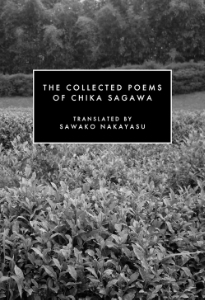
The Collected Poems of Chika Sagawa


The Collected Poems of Chika Sagawa 

Chika Sagawa
The Collected Poems of Chika Sagawa
Translated by Sawako Nakayasu

Canarium Books
http://www.canarium.org

ISBN: 978-0-9849471-6-4


____________________________________

Review of The Collected Poems of Chika Sagawa
by Joel W. Nelson
I believe poetry is the study of language. Unlike spoken language, it is a language of the heart, not visible from the surface. It is the filling of the air with words selected out of deep contemplation. Not a gathering of the meanings of words spoken to be spoken, but an attempt to say something, or to reflect something. Very sparse and most strict, it is a skillfulness right on the brink of burning out like a flame.
          - "When Passing Between Trees"
Sagawa Chika was born in 1911 in Yoichi, Hokkaido in Japan and lived a short life, dying of stomach cancer in 1936. Although she was sickly nearly her entire life, the poems she left behind are brilliant and bold. They are vibrant with color and imagination. Her Collected Poems, translated by Sawako Nakayasu, is a testament to Chika's genius. The translations feel fresh and could easily pass as contemporary work.

Chika's poems are very much a collision of imagination and reality. They are full of unexpected twists and turns. As soon as the reader might begin to reach a level of understanding, Chika is likely to direct the poem in a new direction:
A thicket of asparagus
Dives into the dirty afternoon sun
Their stems cut off by glass
Blue blood streams down the window
And on the other side
Is the sound of a fern unfurling
          - "One Other Thing"
In the prose piece "Had They Been the Eyes of Fish," Chika observes, "Perhaps the way poetry finds expression is by taking materials that had once been reflected in reality and returning them to the realm of thought." When these "materials" are returned to thought, they do not always retain the constraints of reality. There is perhaps a hint of linearity in "One Other Thing," but the way each element is presented is surprising. One would not expect the poet to move from the asparagus diving into the sunset to the blue blood in the window before ending with "the sound of a fern unfurling." The earlier images evoke a kind of chaos, while the final image represents a very slow, deliberate order.

In the essay “Vorticism,” Ezra Pound–whose Imagist ideals were largely extracted from the study of Chinese and Japanese poetry–describes a type of poem “where painting or sculpture seems as if it were 'just coming over into speech.'" This is the poetry of the image. Chika's poetry operates in this sphere, but unlike the stereotypical Japanese image, her images are often abstract:

Rains like flower petals.
Hit by a heavy weight, insects descend the tree shade.
Gathering at the mast wall, trailing a faint breeze – sounds are
   killed by the sun, the waves.
My skeleton places white flowers upon it.
Interrupted by thoughts, fish climb the cliff.
          - "Afternoon"
At first glimpse, "Rains like flower petals" is a simple, if not overwrought simile. The line would normally kill a poem, and yet in the broader context, the line fulfills the function of a surreal image rather than mere simile. If "Afternoon" were to be represented on canvas, perhaps the resulting artwork would be similar to a Salvador Dali painting. Meaning in her poems is often allusive. Wallace Stevens observes in "Adagia," "A poem need not have meaning and like most things in nature often does not have." A reader intent on extracting meaning from Chika's poems will likely come up empty-handed. This is not to say her poetry is meaningless, but rather it is poetry better experienced rather than understood, although the experience of the poem, on its own terms, is itself a sort of understanding.
I have a bit of a fever, my back hurts and I cannot stand up. I eat apples and pears. In the afternoon I chat in quite a loud voice.
          - from "Diary"
One might only speculate what Chika could have accomplished had she lived a longer life. As stunning and impressive as her writing is, it is the work of a young poet brimming with potential but not fully reaching it. And yet ironically, had Chika lived to old age and had these poems been summation her life's work, they would be enough.
____________________________________

Joel W. Nelson spent most of his childhood in the sub-Saharan countries of Burkina Faso and Cote d'Ivoire. He has an MFA in Poetry from Spalding University and lives with his wife and son in Louisville, KY. His poems may be found in the Bellevue Literary Review, the Found Poetry Review, The Louisville Review, and A Narrow Fellow.

Thursday, 21 May 2015

An Interview with Poet Lori Desrosiers

*   *   *   *   *


Lori Desrosiers’ debut full-length book of poems, The Philosopher’s Daughter was published by Salmon Poetry in 2013. A chapbook, Inner Sky is from Glass Lyre Press. A second full-length collection, Sometimes I Hear the Clock Speak, will be out from Salmon in 2016. Her poems have appeared in New Millenium Review, Contemporary American Voices, Best Indie Lit New England, String Poet, Blue Fifth Review, Pirene's Fountain, The New Verse News, The Mom Egg, The Bloomsbury Anthology of Contemporary Jewish-American Poetry and many other journals and anthologies. Her work was nominated for the 2015 Pushcart Prize. She won the Greater Brockton Poets Award for New England Poets award for her poem “That Pomegranate Shine” in 2010. She edits Naugatuck River Review, a journal of narrative poetry. She teaches Literature and Composition at Westfield State University and Holyoke Community College, and Poetry in the Interdisciplinary Studies program for the Lesley University M.F.A. graduate program.

*   *   *   *   *

I met Lori in person at an AWP conference when I read at an off-site reading she set up for contributors to the Naugatuck River Review. It was held at an Irish pub in Seattle and was grand fun. Lori is active in supporting poets and poetry, so when I heard she had a new chapbook coming out of poems related to domestic violence, I jumped at the chance to interview her about it. But before proceeding to the interview, as a way of introduction to Lori's work for those unfamiliar, here is one of her poems from the book.
—Nancy Chen Long

New Season by Lori Desrosiers

I am alive,
running over wet rocks
still tipped with
winter’s frosting.
I almost slip,
barely holding on.
This is the key
to spring’s return
along garden path,
already blooming
with forsythia, cherry.
Soon, marigolds
will ring tomatoes,
peppers, squash,
leaving winter
only a bookmark.

*   *   *   *   *

[This interview was conducted via email in April 2015 and was first published my personal blog.]


image of INNER SKY by Lori Desrosiers
Publisher: Glass Lyre Press
Publication date: March 2015


NCL: Please tell us a little bit about your upcoming chapbook.

LD: Inner Sky is a book about surviving domestic abuse. The voices in the book are based on fact, but are not all autobiographical. The poems expose some of the issues typical in abusive situations such as control, enabling, anger and gaslighting. It is also about leaving, and finding strength and help. I’m hoping these poems will be helpful in some way to others who are going or have been through a similar situation.


NCL: In Gregory Orr’s Poetry as Survival, there’s a quote by Muriel Rukeyser “I don’t believe that poetry can save the world. I do believe that the forces in us wish to share something of our experience by turning it into something and giving it to somebody: that is poetry. That is some kind of saving thing, and as far as my life is concerned, poetry has saved me again and again.” In a Writers Chronical (May/Summer 2014) interview with Leslie McGrath, Camille Dungy said “For me, writing about myself, my family, and my home is a political act. It’s not just confession, it is confronting erasure.” Did you find either one of those be true for you while you were in the process of creating your poetry, and in the sharing of it with others? , and if so, could you elaborate?

LD: Writing about trauma is necessary and incredibly helpful, in that it permits expression of the harder things to say without burdening someone else with the weight of them. It is also a way to step back from the experience and get some perspective, which is conducive to deep healing. I like what Dungy said about confronting erasure. This is what happens when we are in a controlling relationship. The abuser is trying to erase us, and in order to rebuild our inner strength, we need to confront that erasure and find out where we put the person we used to be before the trauma. Perhaps this book is my way of doing what Rukeyser referred to when she said poetry “forces in us a wish to share something of our experience by turning it into something and giving it to somebody.”


NCL: What difficulties or challenges did you encounter in writing some of the poems? in publishing the collection?

LD: These poems were hard for me to write, in that I had to dig deep and revisit traumatic episodes, not only in my life but in my children’s as well. I spoke at length to my daughter about publishing this book, and got her permission to do so. One thing that was hard for me about writing the poems themselves is, because of the content, I was reluctant to send them out individually, but they seem to work well as a collection.


NCL: Did you ever regret including a poem or not including one?

LD: Certainly there are some things I did not write about in this book that could have been included. Perhaps they will come out in future works, perhaps not. There are two poems which are already in my first full-length collection from Salmon Poetry, The Philosopher’s Daughter, which would have fit well in this book. One, entitled “Wedding” ended with the line “If you could only go back and tell yourself to run.” The other was “That Pomegranate Shine” which was about the breakup of a first marriage and the incredible feeling when the woman finds herself on her own and realizes she is going to be all right: “Standing with my children / looking out over the river / the new brides asked me / where I got that pomegranate shine.”


NCL: Audre Lorde wrote “I write for those women who do not speak, for those who do not have a voice because they were so terrified, because we are taught to respect fear more than ourselves. We've been taught that silence would save us, but it won't.” Was activism one of the purposes or goals of the chapbook, e.g., giving voice or increasing awareness? If so, could you tell us a little more about that. Have you given a reading of the poems in the chapbook, and if so, what has been the response?

LD: I have so far only given two readings from this book. It is not an easy collection to read from, since some of the poems trigger strong emotions for me, and yet I believe it is important to do so. I hope it will inspired others to write about their own experiences with abuse and that it may help those, as it says in one of the poems from the book, still “mired in storm.”


NCL: In her essay “Reading the Living Archives: The Witness of Literary Art” (Poetry, May 2011), Carolyn Forché wrote “In the poetry of witness, the poem makes present to us the experience of the other, the poem is the experience, rather than a symbolic representation.” I imagine one would need a great amount of empathy to write a poem that makes present the experience of another. Could you speak a little to the process of creating poetry out of another person’s story or testimony?

LD: These are mostly poems gleaned from personal experience, but some are also inspired by other women’s stories from when I was in support groups after my second divorce. I’ve never thought of myself as greatly empathetic, but when you have gone through the same experience, it is easier to find a common language, even to the extent of being able to finally identify patterns and tendencies to abuse before a relationship even begins.


NCL: Please discuss the choice for a chapbook. For example, why did you choose the chapbook as the vehicle for your poems rather than a book-length manuscript or a section in a book? When you started, did you intend to create a chapbook? How long did it take to write this chapbook (or, alternatively, how did you know it was time to stop writing)?

LD: There certainly were other aspect of the experience I could have written about, but I felt these poems were enough for now. I think a chapbook is a good length also for my purposes, which are to facilitate some writing workshops and to share the book with other women trying to heal from domestic abuse. I have many other topics I write on. For example, my second book, which will be out from Salmon in 2016, is mostly ekphrastic poems in response to music.


NCL: What’s one of the more crucial poems in the chapbook for you? (or what is your favorite poem?) Why? How did the poem come to be?

LD: I decided to share the next-to-last poem in the book, under the third section, “Awakening.” It is entitled “The Ice Crow.” The image of a crow with whitened wing seems to me to symbolize the spirit of transition, in this case between death and new life, which is what a person goes through after a trauma. We gradually shed our winter trappings, but still leave black footprints in snow, still carry that cage on our crooked backs. Nevertheless, we hang up the “gone fishing” sign and hope to lay down the burden of our pain.

The Ice Crow
carries my cage
on crooked back,
head bowed
focus forward,
black feet left tracks
across winter landscape.
Fishing pole tucked
under whitened wing;
tomorrow she plans to
lay down
her burdens
and mine


NCL: In addition to the subject of domestic violence, what are some other themes, metaphors, and other elements of craft did you use to unify your chapbook?

LD: These are also poems of time and place. They are very much set in the 1980’s (one refers to New Wave music) and are set in Long Island and in Connecticut. I varied the pronouns (some are in third person) on purpose, to give several voices and perspectives to the reader, and to also soften the tone in places where a first-person narrative would have been too painful.


NCL: How did you arrive at the title?

LD: I was with a friend at the beach and we were discussing the idea of finding the light inside ourselves in order to be able to live and to write. I think she may have been the one who came up with the words “Inner Sky” and I thank her for that. It is in the title poem, where it says,

That freedom was inner sky
long warm days learning to live alone
made a decision to let go
to give herself permission
to ask herself, “what do I think?” to never
give her power to another again.


NCL: What else would you like readers to know about you or your chapbook?

LD: I think others might be interested in the fact that I went back to school at age fifty for my M.F.A. Sometimes we have to be brave and take a risk to reinvent ourselves.


NCL: What are you working on now?

LD: I have been busy promoting my books as well as teaching and mentoring students. My journal, Naugatuck River Review, which publishes narrative poetry, will be open for contest submissions in July. I am also working on a new online journal, Wordpeace, which is dedicated to peace and justice and features prose (fiction, non-fiction) and poetry in conversation with world events. I am also writing as much as I can, and am very grateful to be member of two critique groups, who inspire me regularly, and because nobody should have to write in a vacuum.

Lori's author website: http://loridesrosierspoetry.com/

Naugatuck River Review: http://naugatuckriverreview.com/

*   *   *   *   *


Nancy Chen Long received a BS in Electrical Engineering Technology and an MBA, worked as an electrical engineer, software consultant, and project manager, and more recently earned her MFA. As a volunteer for the Writers Guild at Bloomington, she coordinates the Lemonstone Reading Series and works with other poets to offer poetry workshops. Her chapbook, Clouds as Inkblots for the Warprone (2013) was published by Red Bird Chapbooks. You'll find her recent and forthcoming work in Superstition Review, DIAGRAM, Mason's Road, Sycamore Review, Boxcar Poetry Review, and other journals. 

Tuesday, 21 April 2015

Lauren Camp: An Interview and Review of THE DAILINESS

The Dailiness,  How do you measure your days?

                                  Review and Interview by Caroline LeBlanc


The Dailiness

            by Lauren Camp

          Edwin E Smith Publishing,
                2013
 
                    67 pages

          ISBN: 978-1-6192755-6-0

          Available on Amazon


About Lauren Camp & How I Know Her

Since moving to Albuquerque in 2012, I’ve noticed that one name, Lauren Camp, keeps coming up in email notices about poetry events—readings and workshops—in the Albuquerque/Santa Fe area.  Her readings are captivating.  Finally, I took one of her workshops and experienced what all the excitement is about.  Lauren is down to earth, energetic, and generous in manner and well versed in literature, art and music.  Since that workshop two of Lauren’s poetry books have won awards. The Dailiness, reviewed here won the National Federation of Press Women 2014 Poetry Book Prize and a World Literature Today “Editor’s Pick.”  A third manuscript, entitled One Hundred Hungers, was selected by David Wojahn for the Dorset Prize. The book will be published by Tupelo Press in 2016.  Lauren is also an award winning artist whose work has been exhibited in solo and group shows as well as other venues around the world.  She also hosts Audio Saucepan, a weekly music & literature Public Radio program (http://ksfr.org/programs/audio-saucepan-ksfr).  Much more information about Lauren, including voice samples, is available on her web page, http://laurencamp.com/index.shtml. The web page itself is an enjoyable experience full of Lauren’s poems, sounds and images.  It is safe to say that Lauren is both a Renaissance woman and a Southwest poetry treasure.
The Review 

The Dailiness contains fifty poems in three sections.  The poems are lyrical journeys through days with the familiar and unfamiliar.  Themes include nature, sound & music, improvisation, time, direction (especially sideways and back looking), place, medical conditions (insomnia and cancer), and family.  In several poems, Camp’s lines give a nod to other poets and writers, including Tillie Olson and Sharon Olds (“Drama Class, 1989”) and Mary Oliver (“To Be Still”).  The list of acknowledgements for journals that previously published the poems in The Dailiness fills 1 ½ pages.
The language and music of Camp’s poems makes them so enjoyable to read that it takes a moment to realize the tragedy of some of the topics, or the riddle created by some of the imagery.  While most of the poems are free verse, there are also a number of form and prose poems.   Before looking at some individual poems, I’d like to share some lines/phrases that grabbed me as I read.
 “I grew/moldy and without promise” (“Unpacked”). 
“And you will not understand the language/but are willing to be carried backward/into the space before sense//where sound rolls sideways in your mouth”(“And Now You Would”).
“Do not get out your knife./My skin knows its angles already” (“Let Me Live in Your Tolerance”).
“The way his hyphen flattened the beveled air” (“The uh-huh of Desire”).

“In the absolute, every moment can go wrong.”(“Clarity”).

“This ground is voracious, but clogged.  We do what we can./We are a people of anticipated guilt”(A Colloquy on Water”). 
“The man who bore/this cross lugged the weight of pardon, mounting it here,/where the shoulder of heat is heaviest”(“Atonement”).

“The merciful comfort of data…. Maybe she had no taste for the soup of her children….[S]he gently read me each drop of the rain” (“How I’d Explain What Kind of Mother She Was”). 
“We walk…into the waltz and step of the ocean, into waves that become blue apostrophes…. Everyone is angled, held in the ever-shrinking linen and spandex of self”(“A Week in L.A.”).  

“[S]top the suffering and ask for exactly what you want…./Crouch into the smear of a tulip, the tragic palette of time”(“When”).  

Next, let’s look at three very different poems.

“My Grandfather and His Eggs” is written in irregularly rhymed couplets and lines of irregular length.  It is about the speaker’s mother’s father who spent his life candling and sorting eggs before he “headed home to boiled eggs.” “He carried his lungs in a shirt pocket, his humor/in a highball glass…./fried his fears.”  This image of a life full of eggs becomes a conceit that crosses generations as the poem moves into first her mother’s reaction to his death, and then the effects of the her mother’s death.
                My mom was fragile when he died.
                We watched her eyes go runny,

                how she slid into the pan
                of what was missing.

                I tell  you grief can lay eggs anywhere.
                Pale and delicate, Mom dreamt her daddy

                in the bowl of heaven.
                She saw Papa in her photos, heard Papa

                in her whispers.  Papa drinking gin,
                Papa over easy.  Now Mom has moved

                through that same membrane, and without her,
                life in our house keeps breaking open.
          
“What You Might Hear” begins with a quote by Ornette Coleman, an innovative jazz musician in the Free Jazz movement of the 1960s (http://en.wikipedia.org/wiki/Ornette_Coleman). In 2007 his album Sound Grammar won a Pulitzer Prize.  The quote reads, “…when I realized I could make mistakes…I  decided I was really on to something.”  The poem is written in irregularly broken and spaces stanzas, the white space between lines and stanzas like the “silence [that] travels sideways, that …is careless and quirky.”  The second stanza warns that “[i]f you/ want answers, you must haul the questions behind you/for a long time until the music starts up, faulty/and brooding.” After several lines describing Coleman’s playing and “[h]is horn, that pliable prophet of conduct,” the poet declares: “If you cannot respond,/he has proven his point, the rate of the measure, his sounds wrenched in error./Where he got them won’t matter.”  The first two lines of this last quote are right justified. 

On the page, and in the auditory pacing, the poem is as innovative as any jazz improvisation.  It ends,    
                                                                                                 He may offer a cure
                                                          contradiction                           
                                                                        paradox    
                                                           a possible
                                                                       furious anthem.
                                                                                              
                                                                                If he offers you meaning, accept.
 
The theme of mistakes, naiveté, recovery and redemption in the face of mistakes, appears in other poems in this collection, but, by far, this poem is the major celebration of the potential hidden in mistakes.

The last poem I’d like to look at is, “The Coming Day,” the penultimate poem in the book.  Its fifteen line pattern is 2/1/2/2/1/2/2/1/2.  Again, line lengths vary, and the rhymes are imperfect, their pattern irregular.  Again, it is the music—the lyrical rhythm and imagery—of the poem that captivates.  It begins with the speaker’s dream—as she puts it “My eyes are inside.”—of song and playgrounds. The focus shifts to the “small seed in the (speaker’s) back yard,”/just a murmur now, but in seven years we will be locked in/with something that really happened, a world that germinated/while we loved.”  These lines are a great example of the poet’s ability to time travel and take the reader with her.  From sleep to a barren but seeded back yard to a world germinated by love. 

The poem’s line breaks are also skillful.  The above break transposes from “a world that germinated/while we loved” into “while we love. The birds will merge with the invisible.”
The enjambment and multiple layers of meaning continue: 

           God will move to the outside, forget us and

           our five-minute increments of sanity.  We are asleep,
           touching particles, sowing atoms of air.  In the morning,"

The poem is pregnant with the liminal fecundity of time, place, the natural world, and dimensions of reality. Passions grow everywhere. 

             ....  Flickers impregnate the eaves.

             The grasses grow.  I hear your heart beat across the down,
             feel your eyes burn along my face.

The last three lines cross the threshold into waking reality, anchored in the ordinary task of eating, but full of promise on the extraordinary table of the bedspread.

                When I am more awake, I sit up, split clementines

                  into sections, line them up along the bedspread
                  count the ripe parcels of the coming day.
We are grounded in the ordinariness of the day even as we “embedded” (forgive me) in the sensual depths of the images.
In summary, The Dailiness, is a stunning collection of evenly intriguing poems that vary as much in content as they do in form and style.  Their music and imagery makes them at once easily accessible and endlessly minable.  
Lauren Camp


The Interview 


Thank you, Lauren for agreeing to this interview in conjunction with my review of The Dailiness on our Poetry Matters blog.  Since you are accomplished in visual and musical venues, as well as poetry and essays, some questions extend beyond this book.  That leads me to my first question. 
 
 
Caroline:  Would you describe your journey to and as a multi-media artist—visual, musical and writer—and how the different media inform your work, overall and each in the others?
Lauren: I came to poetry from art, and to art from magazine writing. I came to music in between, and music informs both the art and poetry. Then, I set art aside because poetry asked me to trust in it, to find it more moments. Poetry writing is filled with what I like about art making: the composition and texture, the negative space, the line.

I had very little exposure to art growing up. I created — sure. I always did. But I had no formal direction, and almost no awareness of any of these forms of expression.

After graduate school and a few jobs, I spent 12 years as a professional working artist. My medium was fabric and thread. I knew nothing of how to manipulate either when I started. This was, perhaps, the joy of it — and the angst. I learned that I like to experiment, and that I won’t do something that has been done. That way of creating has carried over to my work with music and my poetry. (To be clear, I am not a musician; I am a radio host and producer, sliding sounds together to create new associations.)

Poetry lets me color every line and stanza in ways I never dreamed words were meant to be used. I found poetry well into adulthood, and love using it to careen through the visual and sonic possibilities of everything I write.

Caroline:  As the book’s epigraph signals, Dailiness is a travelogue through time and places: inner and outer, public and private, wave and particle.  In fact, the borders we take for granted between these realms become porous in your poems.  For instance, in “What You Might Hear,” you write, “If you/want answers, you must haul the questions behind you/for a long time until the music starts up again, faulty/and brooding.”  What do you understand about how your mind navigates and often erases conventional borders of association?

Lauren:  I don’t understand any part of how my mind works. I know that if something feels too easily “captured,” I must start again — randomizing what I am after. I want both rhythm and curiosity in my work. The material of my own curiosity, I mean. I want to let the why and how of what I’m looking at surprise me.

I know enough to remember to put in the when and where as grounding. After that, I figure I’m free to fly around.

I also want to disrupt rhythm, to throw in some friction. I learned this while making art, and it carries over. Always allow the unexpected, the unplanned, the strange. This is often where the power lies.

Caroline:  Would you speak about how you arrive at such a nuanced balance of narrative, philosophical reflections, and lyricism in your poems?  

Lauren:  Every one of these elements is critical. Narrative provides the detail, but can be flat by itself. Too much reflection becomes some attempt at capturing the conscious self. I like a dark side, but I want to extend that darkness into an understanding, and maybe, hope. Lyricism — oh, thank god for it. It is what makes the process of crafting a poem such a trial and a treasure. The music isn’t there until I’ve almost completed it. I eye every word with suspicion, and go through a lot of revising, playing with spaces and order, the pitch of sound, the pictures I’m drawing with language. I need the words to be much more than words, to be precise and intense and unusual. I need them to stack together, but be sort of slippery.

Caroline:  The book includes both titled and untitled poems, in which the first line serves as the entire or partial title.  What is your decision making process regarding titles?

Lauren:  I have titled hundreds, maybe thousands of poems and artworks. I even give each episode of my radio show a new title. I believe fully in the value of a perfect title. It could be soaked in what is coming, could lay out the echo of the poem, or misdirect the reader.

For example, the poem “When You Leave, Reiterate the Alarm” had several drafts with another title. At some point in the revising, this phrase showed up as the last line of the poem. In the next draft, I pulled it up to the title, and left it there, knowing that was the strongest opening I could give the poem.

Some titles place the reader, as in the poem “At Echo Canyon,” which investigates a phenomenal stone amphitheater in Abiquiu, New Mexico.

Perhaps the quickest to title was “Let Me Live in Your Tolerance.” I wrote the poem shortly after hearing the awful news report, and couldn’t find even the ghost of a title in me. That first draft got by with “Title” as its stand-in. I did one revision (unusually paltry for me), and gave it that title. It came to me whole—almost as a sort of wisdom.

Caroline:  Your poems are full of creative combinations of imagery such as “the enzymes-fixed juice of conclusion (32),” “silence travels sideways (17),” “a furrow of calories (1),” and “The man…lugged the weight of pardon, mounting it here,/where the shoulder of heat is heaviest (34).”  Would you describe how you arrive at such unique combinations of imagery?

Lauren:  I ask my students to look for new ways of describing, to hug unexpected words together to make new concepts. I do this all the time. It requires that I first untether from the normal way to say something, and then “shop” for new ways to approach the subject. I keep a messy desk that drives me nuts, but gives me a whole surface of wild possibilities. I just have to look around, blurring the actual into chance happenings.

Caroline:  What poets most inform your writing?

Lauren:  Many, many, many. Because of my work with Santa Fe Public Radio, I am exposed to a tremendous amount of what is currently being published. My goal every week for my radio show, “Audio Saucepan,” is to find magical or powerful poems that will itch at a listener’s ear. The show interweaves global music and contemporary poetry. I want to select poems each week that offer a way of looking, a truth that is also surprising.

I have stacks of books, and read a lot, often just dipping in. Other times, I find a delicious hour to sit with one or two books, and form a friendship. In this way, I discover a lot of poets, styles, even words. Reading so many books for all these years, I appreciate all the different prisms that writers use to build a sensuous presence.

Certain poems, poets and styles fill me with jealousy (why didn’t I write that?). I know what I like, and I learn easily from these poems. Those that are odder or discomfiting to me, well… I trust them to tell me what I can’t get away with in my writing, or to pull me into their lair so that someday I might claim that approach.

More than anything, after holding all these books and turning their beautiful pages, I am filled with a sense of community. The writers… how extraordinary we are, caring to point to certain places and times, to a certain emotion!

Caroline:  Would you talk about your teaching and how you attempt to impart some of what you know about writing to your students?

Lauren:  I approach teaching with a sense that it is important to share magnanimously whatever I have learned. I work mainly with older adults who wish to write about their life experiences. They don’t care too much about technique at first; they simply love their stories. They need a gentle guide to help them craft their simpler forms into something more fulfilling.

As a child and growing student, I didn’t have any real support for either my artistic or literary impulses. Every week in my classes, I give what I wish I had been given— direction, encouragement, approval. I think of my role as cheerleading for humans who have something to say, and introducing them to the possible techniques and approaches to say it better. I prod them to shape their stories, and encourage them to let the language ripple in front of them. That’s good, fun work.

Caroline:  Anything else you’d like to say about your work as artist, writer, musicologist?

Lauren:  I love all three of these disciplines, and adore even more when they cooperate to make something new.

Thank you, Caroline, for shining a light on my work.

Caroline:  Thank you, Lauren, for your time, poetry, art and love of music.


Monday, 16 March 2015


Imperial, a Royally Good Read
                                               by Barbara Sabol       


By the Numbers:

Imperial, by George Bilgere


Copyright 2014

60 pages

ISBN: 13: 978-0-8229-6268-7


In Sept of 2013 I was fortunate to attend a weekend poetry retreat sponsored by the Ohio Poetry Association at Malabar Farm in Lucas, Ohio, which included a two-day workshop facilitated by George Bilgere. In the course of the weekend, George read several poems from his soon-to-be-released Imperial. His delivery was that of a raconteur whose signature wry observations are tempered by good-natured wit.  Or perhaps the other way around―an impish wit tempered by philosophical musings on the nature of being human. Either way, the audible music of good poetry was reinforced  by the poet's reading, and inspired me to give Imperial, Bilgere's sixth collection of poems, a closer read for review in Poetry Matters.

As in each collection before it, the poems in Imperial are eminently accessible, in the best way possible: Bilgere is a shrewd observer of human behavior (his own included), a lyric storyteller whose narratives dip below the concrete surface to hint at the beating heart of a day-to-day life. An evening walk through a suburban neighborhood takes a "mystical and obscure" turn in "Scorcher;" an obsolete set of Encyclopedia Britannica becomes the ghost of an era when people watched ". . .Gunsmoke/through a haze of Winstons," and which now sit ". . .on a card table in a light rain" in the poem, "Yard Sale." A Duncan Imperial Yo-Yo, with its power to "Split the Atom./Shoot/theMoon," becomes a talisman for  "the lost ten-year-olds of America" in the title poem. In this centerpiece poem, a-brim with a boy's and a nation's sense of wonder and fear and possibility, the nostalgia for America's Camelot is perfectly captured.

As with the Yo-Yo in "Imperial," objects serve as a conduit for memory and for the nostalgic tone that washes, like longing, over the poems in this book. "I love the hoses of summer" begins the wonderful poem "Hoses." In this poem, a common object conjures a childhood memory infused with equal parts sadness and happiness:

     . . .
     I think of my father, armed
     with his scotch and garden hose
     probing the dusk
     with water, the world
     in flames around him,
     booze running the show.

Yet the same memory contains delight, via the garden hose:

     . . .
     my sisters and I would run
     in our swimsuits through the grass
     while he followed us
     with a cold beam of water.

Likewise, in "Coupons," a photograph of the speaker's grandfather conjures the story  of his grandmother as "a pretty sixteen-year-old" who catches the grandfather's eye, while, in present tense, the grandson cuts coupons for his arthritic grandmother. The grandmother recounts that first encounter, when he smiles at his lovely bride-to-be,

     "And that," said Grandma,
     "was that." I snipped out
     another coupon for Campbell's Soup,
     or Borax. Milk of Magnesia.
     Chicken pot pies. Denture cream.

 In the space of five lines, the romantic girl becomes a pragmatic grandmother, via the tell-tale world
of objects that inhabits the grandmother's "stuffy apartment." The fragmentation of syntax into punched out noun fragments at the end of this list of objects further reinforces the implied limits of a once vital life.

Bilgere takes on the poet's task of witness: signaling not only object and action, but delving into dimensions beyond the tangible, directly observable realm. In "Lint," the great topics of love and death are conjured via a wad of lint:

     . . .the lint itself
     is the palpable bond of our union,
     our clothes whirling together and mingling,
     our selves, our very lives,
     becoming lint.

The notion that in every good poem at least two subjects reside is borne out by the work in this collection. The surface wit of the poems shimmers above deeper layers of reflection, so that while the reader may chuckle at a line, the truer and sometimes sad, always poignant meaning bubbles to the surface. However, the reader is not drawn into sadness, as the poet maintains a light touch on the tableaux his poems create. The true subject of  "Musial," for example, is a father's alcoholism and a downward  financial and marital spiral. Stan Musial (the ace Cardinals pitcher from the 50's), is the shining foil against which the failings of the speaker's father are revealed. The poet balances such darkness against wit's lightness when, in the final stanza, he compares Musial's legendary visit to his father's dealership thus:

     . . .
     as when,
     in the old myths, a bored god
     dresses up like one of us, and falls
     through a summer thunderhead
     to shock us from our daydream drabness
     with heaven's dazzle and razzmatazz.

Here, not only the vision of baseball player as mythic god but the music of the those last three lines, in particular, lift us out of the ". . .dark mouths of garages on our street" into a sonically delicious and spirited energy. 

Among the four temperaments, Imperial  is strongest in story and imagination. The poems are context-rich―the reader never has to work out the place, time or figures of a poem. Context is fleshed out by tangible elements that lend a highly imagistic backdrop to the narrative of each poem. Character and setting are forgrounded in these poems, so that we are transported to "summer twilight" in ". . .one of  the green, old,/more or less identical/streets of our neighborhood" in "Scorcher;" in "Desire," we are standing in the grocery store line behind a beautiful young woman, and the reverie angles into the speaker's fantasized future: "The way her dark hair/falls to her narrow waist/makes me ache/to pay for a washer-dryer combo," and the fantasy continues in a split-screen erotic/drolly domestic progression, while the tension of sexual longing is strung against the speaker's ". . .beer and toilet paper and frozen pizzas" on the check-out conveyer.

In most of the poems, however, the context of the past prevails, manifested through a present-day experience or observation. In "Traverse City," for example, we are driving past  ". . .the toy lake where my family came from. . .//The tiny cottages on the shore. . ." and the speaker detours into a reminiscence of summer boyhoods by that lake, made visible by apt and specific description, such that the smell of wind over the water of that lake lifts off the page. In "Arcadia" we are at "the old/Cleveland public golf course" as it's bulldozed into a Walmart, and, again, the speaker drifts back to the vision of  ". . .those men and women/on the distant clearances/and the twinkle of their silver wands/in the morning light. . ." The magic of those "silver wands" carries us to a halcyon era that has to do with so much more than bygone golf courses.

What binds the poems in Imperialinto a reflective and cohesive collection is the silver thread of time. The theme of temporality, and its accompanying tone of nostalgia―a looking back with tenderness, with sadness, w/understanding that comes from time and age―runs through the book. The collection is bookended by elegies that highlight cycles of life, opening with the spreading of Aunt Betty's ashes in the Thames in "As Requested," and closing with "Weather," a tribute to the speaker's father and to familial love that endures every failing:

     My father would lift me
     to the ceiling in his big hands
     and ask, How's the weather up there?
     And it was good, the weather
     of being in his hands, his breath
     of scotch and cigarettes, his face
     smiling from the world below.

The single-stanza poem fast-forwards then to the speaker as a father, lifting his own son, continuing the cycle:

     . . .
     . . .my little boy
     looking down from his flight
     below the ceiling, cradled in my hands,
     his eyes wide and already staring
     into the distance beyond the man
     asking him again and again,
     How's the weather up there?
    
While the structure follows a solid narrative line, this poet's approach to narrative hinges more on a stylistic than structural approach. Signature to Bilgere's style are the concrete language, imagistic rendering of context/scene, informal diction, use of dialogue, and a rhythm created by short lines delivered in a direct style, in a voice that is genuine.

George Bilgere is a poet whose proverbial pen presses firmly on the pulse of human nature, its charming quirks, common drives, universal sadnesses and joys. He is willing to risk the personal to reveal the universal, through this collection of plain-spoken, powerhouse poems, stripped of artifice, pretense, airs. These narratives are delivered via the natural speech line, in colloquial language textured with voices, in a personal, almost confiding manner, so that the reader is drawn in, invested in the tangible details and the insights. We lean into these poems as one would lean across a cafe table to catch the nuance and detail of a friend's story. The poems are populated by evocative objects that haunt the text and induce an atmosphere, a past, a narrative truth that resonates after each poem is read, and re-read. The dynamic of these poems resides in the juxtaposition of the ordinary exterior landscape chafing against the interior emotional life of the poem's speaker, and the power of objects to haunt, to suggest another time and place, memories that shape our perceptions and  take us back to another age, an era when ". . .we entered the Space Age, dogs and men/in orbit,/. . .Cuban missiles pointing/their little heads at us, and voila!" Voila!, indeed.


An Interview with George

Engaging in a close read of Imperial made this collection all the more satisfying. It's the best way to read, I believe, to get down through the strata of a poem, to experience its meaning at the narrative and the symbolic level. Your poetry, at first glance, might appear like straightforward narrative; the mind's eye scans and appreciates the textures and surfaces of your wonderfully tangible and accessible language. However, these poems are deliciously nuanced and layered. There's so much more than meets the mind's eye to each one; an emotional and at times philosophical depth beneath the tangible surface.

One element of the poems in this book is the seemingly very personal "I," the narrator who shares his history, his day-to-day musings, his quandaries and fears. I'd like to begin the interview with a question about the personal nature of the poems. And I would like to thank you, in advance, for this dialogue and for your rich and memorable poetry; book-to-book, I have admired and been inspired by your writing.

The poems in Imperial(and in your previous books, as well) have a very personal feel; a reader can imagine a very fine line between poet and "speaker" of the poem. How much personal risk is involved in writing poems about a dysfunctional family, for example, and about other personal relationships and experiences?

GB: You're right, the two are very close. And I suspect they will keep getting closer. My sense is that the older you get, the farther along you are to being whoever it is you become, the more important it is that you get that person, that self, into the poems. Like most poets, when I was much younger I had much less to say about myself. If I wrote a poem about, say, a turtle, it was pretty much entirely  about that turtle. Nowadays I'd focus more on my reaction to that turtle, to what that turtle speaks to in me. It's important to me, when I'm reading someone's poems, that I get a sense of that person speaking to me. T.S. Eliot's whole "cult of the impersonal" isn't something I find very appealing. So my poems in my recent books tend to be centered around a person very much like me―perhaps an exaggerated version in some respects―moving through the world.

As for the risks of writing about a dysfunctional family―well, do you know of a family that isn't dysfunctional? I mean, if you had a perfectly happy family you'd probably never turn to poetry. In an odd way, we writers have to be grateful for the flaws and foibles of the people who produced us. Without them we wouldn't have anything to write about. To me, the real "risk" in a poem is avoiding the sentimental, the maudlin. And that can be tricky. My own way around this is to try to find the comic edge in the midst of tragedy. I tend to like poems that somehow manage that difficult trick of being both funny and sad.

The figure of the troubled father was prevalent in this collection. You present a rounded perspective of the father, though: there is the drinking, the bravado, the financial failure, yet the speaker expresses tenderness toward the man with "the big hayseed smile." The last poem, "Climate," describes an especially tender memory that says all that needs to be said about love between a parent and child. Have you found poetry to provide a sense of emotional release, a means of reconciling past and present?

GB: I don't know if I've managed a reconciliation between the two. I think the uneasy and always changing relationship between us and our pasts is what fuels so much of our writing. At thirty you think you finally understand your parents. Then at forty you realize you got them all wrong. And at fifty you have to revise the whole thing, usually because you realize that life is much more complicated than you could understand when you were young, and it must have been just as tough for them. I recently became a father myself, and I can only imagine all the bother my son will have to go through figuring me out. I'm already feeling guilty about it. But back to the question: that tension, that slippage between past and present isn't something I think I'll ever resolve. If I do I'll probably stop writing altogether. The dynamic tension between the now and the then is where I locate my poems.

What do you think is the role of poetry in our or in any culture? Do you believe it serves a societal or political function? I was particularly struck by the bald irony in poems like "Mexican Town" and "Far from Afghanistan," which stood out in this collection as statements about the devolution of society via technology-as-interaction and via international conflict.

GB: If you're asking if I think that poetry can serve as an instrument of political change, I guess I'd have to say no, to be realistic. The fact is that most people who read poetry are poets themselves, and are already on our side. It's a strange thing, isn't it, how artists tend almost universally to be liberals, to be on the anti-war, anti-American global domination side of things? I doubt if a supporter of the policies of George Bush or Dick Cheney has ever read one of my poems, and even if they had I don't think there'd be much chance of changing their views. In today's world I think it's the essay, the blog, the viral video, that effects change. The culture has changed a lot since I was young in the '60's. Back then it was actually people mobilizing, marching in the street, demanding that power be taken away from the corrupt and doddering political machine defined by Nixon and McNamara, that got things done, as was the case with the Selma marchers. We tend not to gather publicly and march nowadays. We sit inside and twiddle on our keyboards. I'm sensing a much bigger problem here. . .

Your poems are so wonderfully tangible and textured with specific objects, like lint, hoses, a set of encyclopedias, the Duncan Yo-Yo―the list goes go on and on. (I'm also a child of the 50's and 60's, so many of the tangible references strike a resonant chord.) Please talk about the power or magic of objects, in terms of their evocative power in poetry and also in our lives.

GB: I have a poem somewhere about the rotary phone. I've written about typewriters, bowling alleys. I guess my interest in all that obsolete old stuff comes from my sense that most poetry at its core is elegy. It is the nature of being human to miss the past, to mourn the constant process of change that is always taking everything away from us. We grab onto those old objects of our youth like drowning men. We stuff our attics and basements with the useless junk of the past, perhaps simply to remind ourselves that we really did exist, that we were once at the vibrant center of things. People my age, sixty-ish, watch the kids walk by tapping at their screens and wonder if we're even still here. So those old objects take on an almost talismanic power for us.

Nostalgia seems to be the dominant tone in many of these poems. It's quite the complicated attitude―equal parts longing, sadness, bittersweetness, comfort. I would think it would be difficult to directly translate this full-bodied emotion into one word in another language. Do you aim for the nostalgic touch in your poems or is it something your subjects naturally render?

GB: This is closely related to your previous question. I don't want to seem like some old-timer constantly boring young people with stories of a lost, golden age. But I certainly am prone to severe fits of yearning for the vanished past. Give me my little tea biscuit and I turn into Proust. Again, though, in order to prevent this from becoming incredibly dull I try to find a way to inject some sort of wry humor into my reminiscences. I think you can see that in the encyclopedia poem, "Yard Sale."

Your style of writing is very distinct and  effective in its plain-spoken, direct approach. How has this stripped-down, vernacular style evolved over your years of writing?

GB: My writing is simple, direct, and plain. This is the plainspeak, the common language of my Midwestern forefathers. When I was younger I affected a much high, more vatic language. My influences were people like Yeats and Eliot, Anthony Hecht and Howard Nemerov. But I was just putting on airs, trying, as my grandmother would say, to be better than I was. When I was around fifty―quite old!―I relaxed into speaking the way I really wanted to speak, rather than how I thought a poet should speak. For me, writing in this plain and unadorned diction gives the poems a modest, understated quality, a dry Midwestern sense of humor that isn't possible in the register of a higher diction.

You've been compared to Billy Collins, and that comparison seems apt in the most complimentary way possible. What poets and writers have been your models?

GB: Yes, I can't turn around without someone telling me I sound like Billy Collins. And the similarities are certainly there, especially in terms of the plain diction. But I think many poets are sounding like that nowadays. Just as the High Modernists like Yeats and Pound and Eliot all sound somewhat alike at the turn of the last century, there's something in the air now, or maybe it's in the water, that makes poets like Collins, Tony Hoagland, Steven Dunn, Denise DuHamel, Steven Dobyns, Thomas Lux, all sound a bit similar. We are of our age, and the age is dressed in this rather casual set of clothes. And part of the age, of course, is a kind of highly inflected irony not exactly available to the Modernists, since they hadn't seen Groucho Marx yet, or Woody Allen or Saturday Night Live.

Who are your touchstone poets, the ones you come back to for inspiration and comfort?

GB: I go back to John Donne―always. Thomas Hardy. The great Polish poet and Nobel Prize winner, Wislawa Szymborska, whose voice (though I know it only through translation) seems somehow like the perfect voice for our times.

As an English professor, do you find young students excited about poetry and about literature, in general? Do you feel hopeful that a generation of strong writers and lovers of strong writing is preparing to follow the current generation of established writers?

GB: As for the interest my students, and the students I meet in my travels, have in poetry,  I think they're passionate about it. There are more writing programs in the country now than there ever have been. There are more young poets excited about the possibilities of language and literature than there were, certainly, when I was coming up. I think the future of poetry is in good hands.

I'd be interested in your take on the current dichotomy between "street" and "academic" poetry. Do you feel there are two distinct brands of writing, or that this may be a false dichotomy?

GB: The dichotomy between "street" and "academic" poetry: Yes, I think there's a huge difference, if by "street" you mean rap poetry and performance poetry. In those cases, the emphasis tends to be on the performance itself, whereas in the typical "academic" poetry reading you've got some nice university professor standing at a podium intoning his or her verse. I don't think there's much similarity between the two―which is great. Both worlds have something to offer to the larger conversation.

What project(s) are you working on now? Are there any new themes or subjects you're itching to incorporate into your work?

I was on sabbatical for the past term from John Carroll University here in Cleveland. My wife and little son and I spent the whole time in East Berlin, where I was working on a new collection of poems. My subject, broadly speaking, tends to be America, and I find I write best about it when I'm far away. It was a fantastic trip, and I recommend East Berlin to anyone likes beer and wiener schnitzel!


George Bilgere’s sixth book of poems is Imperial, from the University of Pittsburgh Press. He has won the Cleveland Arts Prize, a Pushcart Prize, the Midland Authors Award, and the May Swenson Poetry Award. Former U.S. Poet Laureate Billy Collins has called Bilgere’s work “a welcome breath of fresh, American air in the house of contemporary poetry.” He has given readings at the Library of Congress, the 92ndStreet Y in New York, and has received grants from the National Endowment for the Arts, the Ohio Arts Council, the Fulbright Foundation, and the Cleveland Partnership for Arts and Culture. His poems are often featured on Garrison Keillor’s The Writer’s Almanac, and he was recently a guest on A Prairie Home Companion. Bilgere teaches at John Carroll University in Cleveland, Ohio.